What if the greatest power for changing your life is not fear of what you might become, but hope in who Christ is making you? John has just told us that we are already the children of God, that what we shall become has not yet fully appeared, and that when Christ appears, we shall be like Him because we shall see Him as He is. Then comes the challenge: “And every man that hath this hope in him purifieth himself, even as he is pure” (1 John 3:3). Biblical hope does not leave us sitting still. Hope gets up. Hope surrenders. Hope removes what no longer belongs. Hope begins living today in light of who Christ promises we are becoming.
Monday, September 28, 2026
Behold What Manner of Love | From Surviving to Thriving as Children of God - 1 John 3:1-2
“Behold, what manner of love the Father hath bestowed upon us, that we should be called the sons of God: therefore the world knoweth us not, because it knew him not. Beloved, now are we the sons of God, and it doth not yet appear what we shall be: but we know that, when he shall appear, we shall be like him; for we shall see him as he is.” — 1 John 3:1–2, KJV
There are seasons in recovery when simply surviving feels like enough. You wake up sober, make it through another craving, resist returning to an unhealthy relationship, refuse to repeat an old behavior, or somehow reach the end of another difficult day without going back to the thing that once controlled you. In those moments, survival is not insignificant. Sometimes making it through the next hour really is a victory worth thanking God for.
But eventually a deeper tension emerges. Is recovery only about avoiding what nearly destroyed us, or is God calling us into something greater? Are we destined merely to spend the rest of our lives trying not to relapse, trying not to fail, trying not to fall apart, or does the gospel offer a vision of life in which we actually begin to grow, flourish, serve, love, mature, and become increasingly like Christ?
Friday, September 25, 2026
Grace That Changes Recovery: Receiving What We Could Never Earn
Celebrate Recovery Lesson 18 — Grace, Forgiveness, Amends, and the Freedom to Move Forward
What if one of the greatest breakthroughs in recovery is not something you accomplish, earn, repay, or prove, but something you finally learn how to receive? We spend so much of recovery looking honestly at what we have done, confronting the harm we have caused, forgiving those who wounded us, and taking responsibility for our part. Then we arrive at a truth that can be surprisingly difficult to accept God offers us grace. Not because we finally became good enough, not because we completed enough steps, and not because we perfectly repaired the past. Grace is the gift we could never earn, and once we begin to understand it, it changes the way we approach God, ourselves, forgiveness, and the people we have harmed. Celebrate Recovery Lesson 18 brings us to this place: receive grace and then learn how to live it.
What Do You Do with a Gift You Cannot Earn?
Recovery teaches us to take responsibility. We learn to stop blaming, stop hiding, stop minimizing, and stop expecting other people to repair what only we can address. We inventory our lives, confess our wrongs, face resentments, offer forgiveness, and begin making amends. Yet when we arrive at the subject of grace, something almost disruptive happens. Grace reminds us that although responsibility matters deeply, our relationship with God is not built upon our ability to become flawless.
We do not purchase God's acceptance through enough good behavior. We do not erase our past through enough meetings, enough apologies, enough service, or enough religious activity. Grace is given. Celebrate Recovery Lesson 18 describes grace as a gift we did not earn and did not deserve, yet one that can profoundly change our lives.
Perhaps that is why grace can be so difficult for those of us in recovery. We understand consequences. We understand regret. We understand shame. We understand trying harder. Receiving something freely can feel almost uncomfortable because so much of life teaches us that everything valuable must somehow be earned. Yet the gospel announces that God has done for us through Jesus Christ what we could never accomplish entirely for ourselves.
Grace Does Not Remove Responsibility — It Changes How We Carry It
There is an important distinction between grace and avoiding responsibility. Grace does not say that what happened does not matter. Grace does not say that nobody was hurt. Grace does not tell us to ignore consequences or avoid amends. Instead, grace allows us to face the truth without believing that the truth must destroy us. We can honestly acknowledge our failures without turning those failures into our permanent identity.
Celebrate Recovery places Lesson 18 alongside Principle 6 and Step 9. Principle 6 calls us to evaluate our relationships, forgive those who have harmed us, and make amends for the harm we have caused, except were doing so would cause further injury. Step 9 likewise calls for direct amends whenever possible, except when doing so would injure the person or others.
That distinction is important because grace does not release us from making things right where we can. Grace gives us the spiritual strength to make things right without attempting to earn redemption through the process. There is an enormous difference between saying, “I am making amends so that I can finally become worthy,” and saying, “Because I have received grace, I now have the courage to take responsibility for what I have done.” One approach is driven by shame and fear, while the other begins with grace and moves toward transformation.
Thursday, September 24, 2026
Confidence at His Coming: Abide, Practice Righteousness, and Keep Rising — 1 John 2:28–29
What if the goal of recovery is not simply making it through another day without falling—but becoming the kind of person who can stand before Jesus Christ with confidence because, one surrendered day at a time, His life has been taking shape within yours? John has spent an entire chapter teaching us how to walk in light, truth, obedience, love, discernment, and abiding faith. Now he asks us to look forward. Christ is coming. The question is not whether we have lived flawlessly. The question is whether we are presently abiding in the One who is making us new.
There is a difference between looking over your shoulder in fear and looking forward in hope. Many of us entered recovery constantly looking backward. We remembered what we did, whom we hurt, what we lost, what nearly destroyed us, and how many times we promised ourselves that things would be different. Even after genuine progress begins, that backward glance can remain powerful. We may wonder whether our past will eventually catch up with us, whether the changes are real, or whether one failure will prove that we have never really changed.
John directs our attention somewhere else. He turns our eyes toward Jesus Christ and says, in effect: Stay with Him. Keep abiding. Keep walking. Keep becoming. The Christian life is not supposed to be lived constantly anticipating condemnation. It is meant to be lived in faithful preparation for the appearing of Christ.
That brings us to an important transition in our journey through 1 John. John began by revealing Jesus Christ as the Word of Life, establishing that transformation begins not merely with better behavior but with encountering and following the living Christ. He then showed us that this life draws us into fellowship with the Father, the Son, and one another—a fellowship that produces a deeper joy than isolation can ever provide. From there we learned that God is light, that recovery requires coming out of hiding, and that confession breaks the power of denial because God faithfully forgives and cleanses those who walk honestly before Him.
When John brought us into chapter two, we learned what happens when imperfect people genuinely trying to walk in the light still stumble: Jesus Christ remains our Advocate with the Father. Grace does not excuse destructive behavior; it gives us somewhere to go when we fail. John then called us into obedience, taught us that walking as Jesus walked inevitably involves learning Christlike love, and reminded us that resentment and hatred can darken our spiritual vision even when healthy boundaries are necessary.
Then came spiritual growth. Children, young people, and fathers became a picture of believers being forgiven, strengthened by the Word, learning the Father, overcoming what once controlled them, and eventually becoming capable of strengthening others. John confronted our attachments through the lust of the flesh, lust of the eyes, and pride of life, reminding us that something we initially possess can eventually begin possessing us. Finally, he reminded us that the world and its desires are passing away while the person who does God's will participates in something enduring.
The closing movement of 1 John 2 then brought us into spiritual discernment. We considered the danger of antichrist deception and departure from truth, the Holy Spirit's anointing and our responsibility to remain grounded in what we have received, the necessity of identifying our Higher Power specifically through Jesus Christ rather than reducing God to an undefined spiritual concept, and finally the command to abide in what we have heard from the beginning. All of that brings us naturally to verses 28–29. John has told us what to remain in. Now he tells us why remaining matters.
John's message is not that spiritually mature people eventually stop needing grace. Everything he has written points in the opposite direction. Those walking in the light confess. Those who stumble have an Advocate. Those who mature continue allowing the Word to abide in them. Those who discern deception remain dependent upon the truth they received. And those preparing for Christ's appearing do not manufacture confidence through their own perfection.
Confidence grows through abiding relationship. As we remain in Christ, His grace forms our character, His truth corrects our thinking, His Spirit redirects our desires, and His righteousness increasingly becomes visible in the decisions we make. Recovery therefore becomes more than counting days away from something. It becomes learning to live every day toward Someone.
Anchor Verse: “And now, little children, abide in him; that, when he shall appear, we may have confidence, and not be ashamed before him at his coming. If ye know that he is righteous, ye know that every one that doeth righteousness is born of him.” — 1 John 2:28–29
John closes this section by joining together three themes that have been developing throughout the letter: abiding, confidence, and righteousness. We abide in Christ now so that we may stand confidently before Him then. We practice righteousness not in order to purchase God's acceptance, but because a life born of God increasingly begins displaying the family resemblance of the righteous Father.
For recovery, this gives us an important definition of thriving. Sobriety is not simply maintaining distance from yesterday's destruction. We are learning to remain close to Christ today. As that relationship deepens, righteousness becomes increasingly practical: honesty replaces deception, responsibility replaces blame, reconciliation replaces unnecessary hostility, boundaries replace unhealthy entanglement, service replaces self-centeredness, and faithful perseverance replaces the old cycle of giving up.
Wednesday, September 23, 2026
Abiding in the Promise — From Surviving to Thriving in Christ | 1 John 2:24-27
You do not have to spend the rest of your life merely trying not to fall apart. God is inviting you into something deeper than survival: to let His truth remain in you, His Spirit guide you, His promise reshapes you, and His life become visible through you. Recovery begins with surrender, but thriving begins when we learn to abide.
There is a difference between visiting a place and making it your home. There is also a difference between occasionally reaching for God when life becomes difficult and learning to abide in Him when life is ordinary, painful, uncertain, beautiful, or overwhelming. The Apostle John brings us back to this distinction in 1 John 2:24–27. He is not merely telling believers to remember something they heard once. He is calling them to allow the truth they received from the beginning to take up permanent residence within them.
For those of us walking a path of recovery, sobriety, spiritual renewal, healing from codependency, navigating a faith crisis, wrestling with doubt, or simply trying to remain faithful through the struggles of everyday life, this becomes incredibly important. Recovery cannot survive indefinitely on crisis management alone. Eventually we have to move beyond simply asking, “How do I make it through today?” and begin asking, “What truth am I allowing to live within me today?”
There is a reason John keeps returning to the foundation of the gospel. He began this letter by speaking about fellowship: “That which we have seen and heard declare we unto you, that ye also may have fellowship with us: and truly our fellowship is with the Father, and with his Son Jesus Christ” (1 John 1:3). Fellowship was never a secondary theme for John. It is at the heart of what salvation produces.
This mirrors the prayer of Jesus in John 17. Christ prayed that His disciples might be one, even as He and the Father are one. Jesus prayed, “That they all may be one; as thou, Father, art in me, and I in thee” (John 17:21). The Father abides in the Son. The Son perfectly walks in the will and purpose of the Father. Through Christ, we are brought into fellowship with God and into covenant fellowship with one another.
Recovery therefore becomes more than abstinence. Sobriety becomes more than the absence of a substance, behavior, relationship pattern, or destructive coping mechanism. We are learning how to live in fellowship again—with God, with ourselves honestly, and with fellow travelers who are learning to walk in grace and truth.
Anchor Verse: “Let that therefore abide in you, which ye have heard from the beginning. If that which ye have heard from the beginning shall remain in you, ye also shall continue in the Son, and in the Father. And this is the promise that he hath promised us, even eternal life.” — 1 John 2:24–25, KJV
John continues: “But the anointing which ye have received of him abideth in you… and even as it hath taught you, ye shall abide in him.” — 1 John 2:27, KJV
There is something important here that can easily be missed. Grammatically, John tells us to let “that which ye have heard from the beginning” abide in us. He is speaking about the apostolic proclamation of Jesus Christ—the gospel they had received. Within that gospel message stands the magnificent promise John immediately identifies in verse 25: eternal life.
The promise does not replace Christ. The promise exists because of Christ. Eternal life is not merely an abstract reward waiting somewhere beyond the grave. Jesus said, “This is life eternal, that they might know thee the only true God, and Jesus Christ, whom thou hast sent” (John 17:3). Eternal life begins in relationship. It begins with knowing God through His Son.
That means we do not have to manufacture our transformation. We are invited to remain in the truth, remain in Christ, listen to the Spirit, and trust the promise of the God who cannot lie. Recovery does not have to rest entirely upon our ability to hold ourselves together. We learn instead to rest our lives upon the faithfulness of the One who holds us.
Devotional Message — Abiding in the Promise
John begins with the words, “Let that therefore abide in you, which ye have heard from the beginning” (1 John 2:24). The word “abide” carries the sense of remaining, continuing, dwelling, staying, and making one’s home. John is not describing a temporary emotional experience. He is describing spiritual permanence. The gospel of Christ is not meant to be something we visit on Sunday morning or reach for only when everything falls apart. It is meant to become the dwelling place from which we understand ourselves, our struggles, our relationships, our future, and our God.
This is why Jesus used similar language with His disciples: “Abide in me, and I in you” (John 15:4). A branch does not produce fruit through frantic effort. It produces fruit because it remains connected to the vine. Jesus continues, “He that abideth in me, and I in him, the same bringeth forth much fruit” (John 15:5). The Christian life is therefore not primarily about trying harder to appear transformed. Transformation is the fruit of remaining connected to Christ. Recovery works similarly. We may begin by desperately attempting to stop destructive behavior, but lasting transformation requires something deeper: a new source of life.
John then connects abiding with fellowship. “If that which ye have heard from the beginning shall remain in you, ye also shall continue in the Son, and in the Father” (1 John 2:24). Notice the movement. The truth remains within us, and we continue in fellowship with the Father and the Son. This takes us directly back to the opening of the epistle and to the High Priestly Prayer of Jesus in John 17. Christianity is not merely believing correct statements about God. It is being reconciled into relationship with God through Jesus Christ and learning to live within that relationship.
Then John reveals the promise: “And this is the promise that he hath promised us, even eternal life” (1 John 2:25). We often hear “eternal life” and immediately think about what happens after death. Certainly, eternal life includes resurrection and everlasting fellowship with God, but John’s writings present eternal life as something that begins now. Jesus declared that knowing the Father and the Son is eternal life (John 17:3). Eternal life therefore changes the quality, direction, and source of our present existence. We begin living today from the reality of the age to come.
This becomes especially powerful when we consider surrender. Many of us encounter surrender through the Third Step of recovery: turning our will and our lives over to the care of God. We often understand that step simply as giving something up. Yet perhaps surrender is also an invitation into relationship. We stop insisting that we can govern every outcome, repair every wound, control every person, silence every fear, or manage every consequence by ourselves. We finally admit that we need God. We need His presence, His truth, His grace, His wisdom, and His life.
That changes the meaning of surrender. Surrender is not spiritual defeat. Surrender is making room for communion. Paul writes, “I beseech you therefore, brethren… that ye present your bodies a living sacrifice” (Romans 12:1). He immediately follows this with the transformation of the mind in Romans 12:2. We place ourselves before God, and God begins reshaping how we think, perceive, respond, desire, and live. We are not simply losing an old life. We are receiving a transformed one.
John concludes this section by speaking about “the anointing” that abides within believers (1 John 2:27), referring to the Spirit’s presence and work. His statement that believers “need not that any man teach you” should not be understood as abolishing pastors, teachers, mentors, counselors, sponsors, or spiritual community. John himself is teaching them through the letter. His point is that deceptive teachers do not possess some secret spiritual knowledge necessary for salvation. The Spirit bears witness to the apostolic truth they have already received. Jesus promised that the Spirit would guide His disciples “into all truth” (John 16:13). We therefore remain teachable without becoming spiritually gullible. We listen, discern, test what we hear, and return repeatedly to the truth revealed in Christ.
Recovery Focus — Surrendering Into Relationship
For many people, recovery initially feels like survival. We count hours, days, weeks, months, or years. We avoid places, people, behaviors, thoughts, and situations that once carried enormous power over us. There is wisdom in this. Scripture itself teaches vigilance: “Be sober, be vigilant” (1 Peter 5:8). Yet vigilance was never meant to become perpetual terror. Eventually recovery must become more than running away from what nearly destroyed us. We begin learning what we are running toward.
John gives us an answer: fellowship with the Father and the Son. The recovering life is not merely the elimination of destructive habits. It is the construction of a new way of living. Paul describes this beautifully when he says we should “walk in newness of life” (Romans 6:4). Sobriety creates space, but Christ gives that space purpose. Healing removes chains, but fellowship teaches us how to walk in freedom.
This is where surrender becomes profoundly relational. When we turn our will and our life over to the care of God, we are not simply handing God a list of problems. We are giving ourselves permission to become dependent upon Him. That can feel frightening for someone whose life has been shaped by abandonment, trauma, betrayal, disappointment, codependency, compulsive control, or spiritual disillusionment. We may have spent years believing that if we do not control everything, everything will collapse. Yet Scripture invites us to discover another way: “Trust in the LORD with all thine heart; and lean not unto thine own understanding” (Proverbs 3:5).
Abiding teaches us that dependence upon God is not weakness. It is spiritual alignment. Jesus Himself continually submitted His will to the Father. In Gethsemane He prayed, “Nevertheless not my will, but thine, be done” (Luke 22:42). If surrender characterized the earthly ministry of Christ, surrender cannot reasonably be considered failure in our lives. Surrender becomes the doorway through which we stop demanding control and begin receiving grace.
John also warns about “them that seduce you” (1 John 2:26). Recovery has its own forms of seduction. Addiction whispers that one more time will not matter. Codependency whispers that we are responsible for another person’s emotions. Fear tells us catastrophe is always around the corner. Shame tells us our worst moment is our true identity. Doubt tells us that uncertainty means God has abandoned us. Spiritual deception frequently begins by convincing us to abandon what we know is true in exchange for what promises immediate relief.
Scripture provides another path: “Thy word have I hid in mine heart, that I might not sin against thee” (Psalm 119:11). Abiding truth becomes an internal anchor. When the old lie appears, we have something with which to answer it. When shame tells us we are permanently condemned, Romans 8:1 reminds us, “There is therefore now no condemnation to them which are in Christ Jesus.” When fear insists that we cannot endure another day, 2 Timothy 1:7 reminds us that God has not given us “the spirit of fear; but of power, and of love, and of a sound mind.”
This does not mean that every craving disappears, every question is immediately answered, or every moment of anxiety evaporates. Abiding is not emotional perfection. Abiding means knowing where we remain when emotions fluctuate. Our feelings may rise and fall. Our confidence may strengthen and weaken. Our circumstances may change unexpectedly. Yet Jesus Christ remains “the same yesterday, and to day, and for ever” (Hebrews 13:8). Recovery becomes increasingly stable when our identity rests in something more permanent than our present emotional condition.
Eventually we begin moving from surviving to thriving. Thriving does not mean living without struggle. It means our struggles no longer possess exclusive authority over our story. The recovering person begins discovering purpose, community, service, courage, gratitude, and spiritual maturity. We stop introducing ourselves internally only by what nearly destroyed us. We begin understanding ourselves through what God is creating within us. “If any man be in Christ, he is a new creature” (2 Corinthians 5:17).
Wisdom and Grace — Living from the Life God Has Promised
The promise of eternal life gives recovery an entirely different horizon. We are no longer merely trying to preserve the life we currently possess. We are participating in the life God is producing within us. Peter describes believers as those who have been “begotten… again unto a lively hope by the resurrection of Jesus Christ from the dead” (1 Peter 1:3). Recovery becomes rooted in resurrection. Something can die without the story ending there.
That matters because many of us enter recovery grieving. We grieve wasted years, broken relationships, damaged trust, opportunities we lost, choices we regret, beliefs that collapsed, or versions of ourselves we can no longer recover. Grace does not always restore everything exactly as it was. Sometimes grace does something more profound: it creates something new. God says through Isaiah, “Behold, I will do a new thing” (Isaiah 43:19). We learn to stop demanding that redemption look exactly like reversal.
Grace also teaches patience. Philippians 1:6 reminds us that “he which hath begun a good work in you will perform it until the day of Jesus Christ.” Recovery often exposes our impatience with ourselves. We want transformation immediately. We want twelve months of growth in twelve days. We become discouraged because an old thought appears, a trigger catches us unexpectedly, grief returns, or doubt revisits us. Yet spiritual formation usually happens through repeated choices of faithfulness rather than one dramatic moment of perfection.
This is why abiding is such powerful language. Abiding removes the obsession with instant results. A tree does not panic because fruit has not appeared one hour after rain falls. Roots grow invisibly before fruit appears visibly. Colossians 2:7 describes believers as “rooted and built up in him and stablished in the faith.” Recovery includes hidden seasons where roots are growing even when we cannot yet see evidence above the surface.
Wisdom also teaches us the difference between temptation and identity. James writes that temptation draws us through disordered desire, and when that desire is embraced it produces destructive consequences (James 1:14–15). Temptation therefore deserves attention, but temptation does not define us. A craving is not a command. A thought is not an identity. A feeling is not a prophecy. A moment of doubt is not apostasy. We can experience something internally without surrendering authority to it.
The Spirit strengthens this process. Paul writes, “Walk in the Spirit, and ye shall not fulfil the lust of the flesh” (Galatians 5:16). Notice again that the emphasis is relational and directional. We walk. We remain. We listen. We follow. Recovery becomes a daily spiritual rhythm rather than a single decision we made years ago. Yesterday’s surrender was meaningful, but today still requires surrender. Yesterday’s prayer strengthened us, but today still invites prayer.
God also provides community. Ecclesiastes says, “Two are better than one,” and adds that when one falls, another can help him rise (Ecclesiastes 4:9–10). John’s theology of fellowship refuses the fantasy of isolated spirituality. We need fellow travelers. We need people who can remind us of truth when our thinking becomes distorted. We need relationships where honesty is welcomed, accountability is practiced, boundaries are respected, and grace is present.
Paul gives us one final image that beautifully synthesizes all of this. He tells the Corinthians, “Ye are our epistle written in our hearts, known and read of all men,” and describes them as “the epistle of Christ… written not with ink, but with the Spirit of the living God” (2 Corinthians 3:2–3). The recovering life becomes a living testimony. We do not merely speak about grace. Over time, grace becomes visible in how we respond, forgive, set boundaries, admit mistakes, endure hardship, serve others, and walk humbly with God. We become living epistles of what God can accomplish through surrendered lives.
P.R.O.M.I.S.E. — Learning to Abide
The word PROMISE captures the center of John’s message: “This is the promise that he hath promised us, even eternal life” (1 John 2:25). Recovery becomes stronger when we stop building our identity entirely around what we are resisting and begin building our lives around what God has promised. P.R.O.M.I.S.E. gives us a practical framework for remembering how to abide when life becomes difficult.
P — Plant the Truth Deeply
“Let that therefore abide in you, which ye have heard from the beginning” (1 John 2:24). Plant the gospel deeply enough that it becomes the place your mind instinctively returns when fear, shame, craving, or confusion appears. Colossians 3:16 says, “Let the word of Christ dwell in you richly.” Do not merely encounter truth occasionally. Give truth permission to live within you. Read it, meditate upon it, pray through it, speak it, remember it, and return to it repeatedly.
R — Remain in Christ
Jesus said, “Abide in me, and I in you” (John 15:4). Recovery teaches us that isolation is dangerous. Spiritually, separation from the source of life is equally dangerous. Remaining in Christ means continually returning to prayer, Scripture, fellowship, worship, honest confession, and obedience. We do not remain because we never struggle. We remain because we know where life is found when struggle comes.
O — Obey the Truth You Know
Earlier John wrote, “He that saith he abideth in him ought himself also so to walk, even as he walked” (1 John 2:6). Abiding produces movement. Truth becomes embodied through obedience. Sometimes recovery becomes complicated because we keep searching for a new revelation while ignoring something God has already made clear. The next faithful step may not be dramatic. It may simply mean making the phone call, keeping the boundary, telling the truth, attending the meeting, praying again, apologizing, resting, or refusing the old behavior.
M — Make Room for the Spirit
John says that “the anointing which ye have received of him abideth in you” (1 John 2:27). Jesus promised that the Spirit would guide His followers “into all truth” (John 16:13). Make room for the Spirit by becoming quiet enough to listen and humble enough to be corrected. The Spirit will never lead us away from Christ or contradict the truth God has revealed. His work continually brings us back toward truth, holiness, love, conviction, wisdom, and Christlike character.
I — Identify the Lie
John writes because there are those attempting to “seduce” believers (1 John 2:26). Every destructive pattern survives through some form of deception. “I cannot handle this without using.” “If I say no, they will leave.” “God could never forgive me.” “Nothing will ever change.” “Everyone else has it together except me.” Identify the lie and bring it into the light. Jesus said, “Ye shall know the truth, and the truth shall make you free” (John 8:32). Freedom grows where deception loses secrecy.
S — Surrender Your Will Today
“Present your bodies a living sacrifice” (Romans 12:1). Surrender does not happen only once. There may have been a defining moment when you first turned your life toward God, but abiding requires ongoing surrender. Today has its own fears, desires, expectations, relationships, disappointments, and decisions. We therefore return again: God, here is my will. Here is my life. Here is what I cannot control. Teach me to walk in Your wisdom today.
E — Embody Eternal Life
Jesus said, “This is life eternal, that they might know thee the only true God, and Jesus Christ” (John 17:3). Eternal life is our future hope, but its transforming power enters our present life. Embody the promise through the way you live. Become the living epistle Paul described in 2 Corinthians 3:2–3. Let people encounter patience where anger once ruled, honesty where secrecy once lived, boundaries where codependency once flourished, humility where pride once defended itself, and hope where despair once seemed permanent.
Thoughtful Reflection
Perhaps the deeper question today is not simply, “Am I sober?” or even, “Am I doing better?” Perhaps the deeper question is, “What is abiding in me?” What messages have been given permission to make a home in my heart? Is shame abiding there? Fear? Resentment? The voice of someone who wounded me years ago? The belief that I will never change? Or am I increasingly allowing the truth of Christ to occupy that space?
There is also another question worth asking: What if surrender is not primarily about losing control but about discovering communion? When we turn our will and life toward the care of God, perhaps we are finally admitting that we were never designed to carry ourselves alone. Surrender opens the door to fellowship. Fellowship teaches us abiding. Abiding reshapes identity. And identity begins transforming behavior.
That means your struggle does not disqualify you from fellowship with God. Your questions do not automatically separate you from Him. Your moments of fear do not cancel His promise. Even when faith feels fragile, you can remain. You can pray honestly. You can return to the truth. You can ask for help. You can allow others to walk beside you. Abiding is often less dramatic than we imagine. Sometimes abiding simply means refusing to walk away.
And as we remain, something begins happening almost imperceptibly. We become living epistles. Others begin reading the story of grace through our lives. Not because we became flawless, but because we became honest. Not because we never struggled again, but because struggle no longer had the final word. We become witnesses that God still restores, still teaches, still leads, still transforms, and still keeps His promises.
Call to Action — Today’s Challenge
Today, identify one message that has been abiding within you that does not belong there. Maybe it is shame. Maybe it is fear. Maybe it is resentment, hopelessness, self-condemnation, a craving, an old identity, or the belief that you have to control everything.
Write that message down.
Then place beside it one truth from Scripture that answers it.
Spend a few quiet moments praying something simple:
“Father, I surrender again today. Let Your truth abide in me. Teach me to remain in Christ. Help me recognize deception, listen to Your Spirit, receive Your grace, and live from the promise of eternal life. Let my life become a living epistle of what Your grace can accomplish. Amen.”
Then carry one word with you throughout the day:
PROMISE.
- When fear rises, remember the promise.
- When temptation whispers, remember the promise.
- When doubt appears, remember the promise.
- When yesterday tries to define you, remember the promise.
- When recovery feels exhausting, remember the promise.
God is not merely calling you to survive another day.
He is teaching you to abide.
And as you abide in Christ, remain in His truth, walk by His Spirit, and live within the fellowship of the Father and the Son, recovery begins becoming something more than escape from the old life.
It becomes participation in the new one.
Continue with me in our next devotional as John moves from Abiding in Christ into Confidence at His Coming — 1 John 2:28–29. John will show us that abiding does more than sustain us through today. It prepares us to stand before Christ with confidence rather than shame.
From surviving to thriving, we remain.
We abide.
And we live from the promise.
Tuesday, September 22, 2026
Who Is Your Higher Power? Denying Self, Confessing Christ, and Finding True Recovery | 1 John 2:22–23
What if one of the most dangerous lies in recovery is not that you cannot change—but that you can ultimately save, define, and restore yourself? John confronts us with a harder truth: freedom begins when we stop placing ourselves at the center and confess Jesus Christ as Lord.
I want to say this right out of the gate: I am deeply grateful for secular recovery rooms. They have created spaces where people carrying addiction, alcoholism, trauma, family dysfunction, shame, grief, and brokenness can sit across from one another and say, “I understand.” Fellow travelers have helped fellow travelers make a way forward using the tools they had available. I have personally benefited from those rooms, and I would never casually dismiss the lives that have been changed through fellowship, accountability, inventory, amends, meetings, sponsorship, honesty, and service.
At the same time, gratitude does not require us to stop asking difficult questions. One familiar phrase appearing throughout recovery culture is, “To thine own self be true.” I understand the intended meaning: stop pretending, stop living dishonestly, stop constructing a false version of yourself for everyone else. There is wisdom in becoming honest about who we are. But for the Christian, recovery cannot ultimately end with being true to ourselves. Scripture calls us somewhere deeper: to surrender the false self, deny the self that insists upon ruling our lives, and discover our identity in Jesus Christ.
Here is the tension. Recovery teaches surrender. Step Two speaks about a Power greater than ourselves. Step Three speaks about turning our will and our lives over to the care of God as we understand Him. Yet modern spirituality can sometimes transform that surrender into another form of self-direction. God becomes whatever I define God to be. Truth becomes whatever feels authentic to me. Spirituality becomes whatever helps me achieve my preferred version of myself.
For followers of Jesus Christ, however, surrender cannot remain undefined. We are not merely surrendering to spirituality. We are surrendering to Someone. We are not merely looking for transcendence. We are being reconciled to the Father through the Son. We are not creating our identity; we are receiving a new identity in Christ.
Please do not hear what I am not saying. This is not an indictment of every AA meeting, ACA room, recovery community, therapist, sponsor, or person who has found help in secular recovery. I have encountered extraordinary people in those spaces. I have also experienced environments—both in person and on social media—where openly identifying Jesus Christ as the foundation of recovery was treated with suspicion, ridicule, or hostility.
That is where today's passage becomes uncomfortable, challenging, and incredibly relevant.
Anchor Verse: “Who is a liar but he that denieth that Jesus is the Christ? He is antichrist, that denieth the Father and the Son. Whosoever denieth the Son, the same hath not the Father: but he that acknowledgeth the Son hath the Father also.” — 1 John 2:22–23, KJV
John does not leave the identity of Jesus open-ended. Jesus is not merely one spiritual teacher among many. He is not simply an example of enlightenment, a recovery metaphor, an inspirational figure, or one possible pathway toward God. John declares that Jesus is the Christ. The Messiah. The Son.
And John makes an inseparable connection: what we do with Jesus determines what we are doing with the Father.
John writes pastorally, but he does not write timidly. False teachers were troubling the early Christian community, and believers needed discernment. John had already warned them about “many antichrists” in 1 John 2:18. His concern was not merely predicting some mysterious figure at the end of history. His immediate concern was teaching believers how to recognize a message that denied or displaced the true identity of Jesus Christ.
That distinction matters. John's language should never become permission for Christians to arrogantly insult everyone who struggles with doubt, wrestles with faith, belongs to another tradition, or walks into a recovery room uncertain what they believe. John is identifying a theological claim: denying Jesus as the Christ separates a person from the confession at the heart of the apostolic gospel.
For those of us walking the road of recovery, that brings the question directly home: Who sits at the center of my recovery?
Monday, September 21, 2026
You Already Know the Truth: Anointed by the Holy One | 1 John 2:20–21
What if recovery is not about finding a new identity, but remembering the truth addiction, shame, codependency, and approval-seeking taught us to forget? John says we have an anointing from the Holy One—and that truth changes how we understand who we are and how we live.
What if recovery is not always about discovering some new thing we have never known before? What if part of recovery is awakening again to truth we once heard, once believed, perhaps even once lived, but gradually buried beneath addiction, codependency, resentment, fear, people-pleasing, shame, compulsive behaviors, and the exhausting search for external validation? There are seasons when bondage does not merely change what we do; it distorts what we remember about God, ourselves, other people, and the life we were created to live. We may spend years trying to construct a different identity when grace is inviting us to return to the truth from which we slowly wandered.
For the longest time, I have said that one of the beautiful things about recovery is rediscovering who you are. Yet I am beginning to understand that there is something deeper taking place. Recovery is not simply rediscovering who I am in Christ as though my identity had completely vanished. It is allowing Christ to restore my understanding of what has always been true about Him and what becomes true of me through fellowship with Him. Addiction told me what I needed. Codependency told me whom I needed to rescue. Fear told me what I had to control. Shame told me what I was worth. The hunger for validation told me whose approval I needed before I could feel secure. John brings us back to something far more stable: “ye have an unction from the Holy One.”
That does not mean every thought buried somewhere inside us is trustworthy, nor does it mean human beings possess divine truth independently of God. John has spent this entire letter grounding truth in Jesus Christ, the Word of Life who was heard, seen, witnessed, and proclaimed. The truth we are recovering is the truth received from Christ, preserved in His Word, confirmed through His Spirit, and lived within genuine fellowship with the Father, the Son, and one another. Recovery becomes restoration when the lies that governed our lives finally begin losing their authority.
Anchor Verse: “But ye have an unction from the Holy One, and ye know all things. I have not written unto you because ye know not the truth, but because ye know it, and that no lie is of the truth.” — 1 John 2:20–21, KJV
These words come immediately after John warns his readers about deception, departure, and those he describes as antichrists. In the previous passage, the atmosphere felt urgent: false voices existed, counterfeit teachings were spreading, and believers needed discernment. Yet John does not leave Christians frightened, suspicious, or spiritually defenseless. His next words are not, “You had better figure everything out before you are deceived.” Instead, he reassures them: you have an anointing from the Holy One, and you know the truth.
That is an important transition for everyone walking through recovery, sobriety, spiritual reconstruction, grief, relational healing, or a season of doubt. Discernment is not meant to produce paranoia. Truth is not something God hides from us while demanding that we somehow guess correctly. The Christian life is lived in relationship with the One who declared, “I am the way, the truth, and the life” (John 14:6). The same Christ who calls us away from darkness does not abandon us halfway through the journey. He teaches us, corrects us, restores us, and continually calls us to remain in what is true.
Friday, September 18, 2026
Antichrists & the Last Hour: Discernment, Recovery, and Standing Firm in Christ
What if one of the greatest threats to your recovery is not the temptation you immediately recognize—but the lie you have slowly learned to tolerate? Recovery is not only a battle against substances, compulsions, destructive behaviors, or old environments. It is also a battle over what we believe. The voice saying, “One time will not hurt.” The voice whispering, “You will always be this way.” The thought insisting, “Nobody understands you, so isolate.” The shame declaring, “After everything you have done, God cannot possibly want you.” Deception rarely announces itself as deception. More often, it sounds reasonable right up until it begins leading us away from life.
That is why John's warning in 1 John 2:18–19 matters so deeply for Christian recovery. John tells his readers that they are living in “the last time” and that “many antichrists” have already appeared. His purpose is not to create panic, obsession, or speculation. John is teaching believers how to recognize voices that oppose the truth about Jesus Christ and how to remain anchored when deception attempts to pull them away.
For those rebuilding life through sobriety, discipleship, and spiritual renewal, this becomes an invitation to develop spiritual discernment. We learn to distinguish truth from counterfeit truth, conviction from condemnation, healthy accountability from shame, godly community from destructive influence, and the voice of Christ from the old voices that once governed our lives.
The Battle Beneath the Battle
Every visible struggle has something happening underneath it. Behind a craving may be loneliness. Behind anger may be fear. Behind isolation may be shame. Behind rationalization may be an old belief we have never challenged. John directs our attention beneath the surface. The deepest battle is ultimately a battle concerning truth: Who is Christ? Whose voice will we trust? What story will define us? And where will we remain when competing voices begin pulling us away?
Learning to Recognize the Counterfeit
A counterfeit succeeds because it resembles something genuine. In the same way, destructive thinking rarely introduces itself by saying, “I am here to destroy your recovery.” Instead, it sounds like relief. It sounds like independence. It sounds like entitlement. It may even sound spiritual. Recovery therefore requires more than avoiding obvious danger. It requires learning to test the voices, thoughts, influences, relationships, and beliefs shaping our decisions.
Christ Has Not Left Us Defenseless
The encouraging truth is that Scripture does not merely warn us about deception and then leave us afraid. God equips His people. John will immediately remind his readers that they possess an anointing from the Holy One and know the truth. Paul tells believers to put on the whole armor of God. Christ teaches His disciples to abide in Him. The Christian life is therefore not a desperate attempt to survive spiritual attack through willpower. It is a life of learning to stand in what Christ has already provided.
Anchor Passage — 1 John 2:18–19
“Little children, it is the last time: and as ye have heard that antichrist shall come, even now are there many antichrists; whereby we know that it is the last time.
They went out from us, but they were not of us; for if they had been of us, they would have continued with us: but they went out, that they might be made manifest that they were not all of us.”
— 1 John 2:18–19, KJV
From Surviving Recovery to Thriving in Sobriety
There is an important difference between surviving recovery and learning to thrive in recovery. Survival says, “I somehow made it through another day.” Thriving begins asking, “What kind of person is Christ forming me into today?” Survival focuses primarily on avoiding the substance, behavior, or destructive pattern. Thriving develops truth, integrity, community, emotional maturity, spiritual discernment, purpose, service, and an increasingly Christ-centered identity.
John's language about remaining becomes especially meaningful here. Recovery is not established through one dramatic decision but through thousands of smaller decisions to remain. We remain honest when secrecy feels easier. We remain connected when isolation feels safer. We remain teachable when pride tells us we already know enough. We remain in prayer when God seems distant. We remain anchored in Christ when shame tells us to run.
And when someone stumbles, struggles, or relapses, 1 John 2:19 should never be weaponized to declare that they were never sincere or that God has discarded them. John's immediate concern is doctrinal departure from the apostolic witness concerning Christ. Recovery application must therefore remain pastoral: a setback exposes something requiring attention, honesty, support, repentance, treatment, accountability, or renewed surrender. It does not give us permission to pronounce final judgment over another person's heart.
Devotional Message — Discernment in the Last Hour
John begins with an unusual urgency: “Little children, it is the last time.” The language is not intended to send believers searching obsessively for dates and timelines. It awakens them to the spiritual seriousness of the age in which they live. The decisive work of Christ has occurred, yet deception remains active. For the recovering believer, that same urgency reminds us that today matters. Recovery cannot forever be postponed until circumstances become easier. Forgiveness cannot endlessly be delayed. Truth cannot continually be negotiated. There comes a moment when we must recognize that spiritual maturity is formed through what we choose today.
John then introduces the disturbing reality of “many antichrists.” Later he explains the heart of the problem: “Who is a liar but he that denieth that Jesus is the Christ? He is antichrist, that denieth the Father and the Son” (1 John 2:22, KJV). John's language is fundamentally Christological. The issue is not whether someone irritates us, disagrees with us, disappoints us, or leaves our congregation. The spirit of antichrist opposes, distorts, or denies the truth of Jesus Christ. Spiritual discernment therefore begins by keeping Christ—not fear, personalities, controversy, or speculation—at the center.
This matters enormously in Christian recovery because addiction itself flourishes through distortion. It teaches us to call bondage freedom, isolation protection, impulsivity authenticity, intoxication relief, secrecy privacy, and self-destruction comfort. Jesus moves in the opposite direction. He said, “If ye continue in my word, then are ye my disciples indeed; And ye shall know the truth, and the truth shall make you free” (John 8:31–32, KJV). Notice the connection between continuing and freedom. Truth is not merely something we hear once. We continue in it until it begins reshaping the way we live.
Discernment therefore requires examination. John later writes, “Beloved, believe not every spirit, but try the spirits whether they are of God: because many false prophets are gone out into the world” (1 John 4:1, KJV). In recovery language, we could say: do not automatically believe every thought simply because it occurred inside your mind. Do not automatically trust every impulse simply because it feels powerful. Do not accept every cultural message about alcohol, drugs, sexuality, money, resentment, pleasure, identity, or success simply because it is repeated frequently. Test what you hear against the character and teaching of Christ.
Paul describes this transformation in Romans 12:2: “And be not conformed to this world: but be ye transformed by the renewing of your mind, that ye may prove what is that good, and acceptable, and perfect, will of God.” Recovery requires renewed thinking because old behavior is frequently sustained by old beliefs. If the belief remains untouched, the behavior continues looking attractive. Christian sobriety moves deeper than behavioral restraint. Christ begins renovating the thought patterns from which choices emerge.
This is where spiritual warfare becomes practical rather than sensational. Paul writes, “Finally, my brethren, be strong in the Lord, and in the power of his might. Put on the whole armour of God, that ye may be able to stand against the wiles of the devil” (Ephesians 6:10–11, KJV). Notice where strength originates in the Lord. Recovery becomes exhausting when we attempt to manufacture enough personal strength to guarantee that we will never struggle again. Scripture gives us a different posture. We stand in borrowed strength—the strength of Christ operating through truth, grace, obedience, community, prayer, and continual dependence.
Finally, discernment leads us toward abiding. Jesus said, “Abide in me, and I in you. As the branch cannot bear fruit of itself, except it abide in the vine; no more can ye, except ye abide in me. I am the vine, ye are the branches” (John 15:4–5, KJV). Recovery is not merely learning how to stop doing something destructive. It is learning where to remain. We remain in Christ. We remain in truth. We remain connected to healthy people. We remain teachable. We remain willing to confess, repair, forgive, learn, and grow. That is how spiritual resilience develops.
Recovery Focus — Recognizing the Voices That Pull Us Away
The path toward relapse often begins long before the substance is consumed or the destructive behavior returns. James describes temptation as a process: “But every man is tempted, when he is drawn away of his own lust, and enticed. Then when lust hath conceived, it bringeth forth sin: and sin, when it is finished, bringeth forth death. Do not err, my beloved brethren” (James 1:14–16, KJV). That final warning—do not err—is about deception. The recovering person learns to notice the movement before it becomes momentum.
One of the first deceptive voices says, “You are strong enough now that you do not need to be vigilant.” Peter gives the opposite counsel: “Be sober, be vigilant; because your adversary the devil, as a roaring lion, walketh about, seeking whom he may devour: Whom resist stedfast in the faith” (1 Peter 5:8–9, KJV). Vigilance is not living frightened every day. It is knowing ourselves well enough to recognize vulnerable moments. Hunger, anger, loneliness, exhaustion, resentment, grief, celebration, romantic disappointment, financial pressure, and spiritual discouragement can become openings through which old thinking returns.
Another deceptive voice says, “Do not tell anyone.” Addiction grows exceptionally well in secrecy. Recovery flourishes in truthful connection. Hebrews warns, “But exhort one another daily, while it is called To day; lest any of you be hardened through the deceitfulness of sin” (Hebrews 3:13, KJV). Notice again the connection between sin and deception. Community helps us see what we cannot always see alone. A sponsor, pastor, mentor, counselor, trusted friend, recovery group, or mature believer may recognize our drift before we recognize it ourselves.
Healthy community also changes how we respond when someone struggles. Paul writes, “Brethren, if a man be overtaken in a fault, ye which are spiritual, restore such an one in the spirit of meekness; considering thyself, lest thou also be tempted. Bear ye one another's burdens, and so fulfil the law of Christ” (Galatians 6:1–2, KJV). Biblical recovery is not a community standing around waiting to expose failures. It is a community committed to restoration. Accountability without grace becomes punishment. Grace without accountability becomes permission. Christ-centered recovery holds both together.
Discernment also requires the courage to ask God to expose what remains hidden within us. David prayed, “Search me, O God, and know my heart: try me, and know my thoughts: And see if there be any wicked way in me, and lead me in the way everlasting” (Psalm 139:23–24, KJV). That prayer is dangerous to our denial but life-giving to our recovery. We invite God to reveal resentments we have justified, relationships we have romanticized, compromises we have minimized, wounds we have avoided, and attitudes we have protected.
Yet vigilance should never become hopelessness. Paul assures believers, “There hath no temptation taken you but such as is common to man: but God is faithful, who will not suffer you to be tempted above that ye are able; but will with the temptation also make a way to escape, that ye may be able to bear it” (1 Corinthians 10:13, KJV). The temptation may be powerful, but it is not sovereign. The craving may scream, but it does not command. The old pattern may feel familiar, but familiarity does not make it destiny. God remains faithful, and recovery teaches us to start looking for the way of escape before the pressure becomes overwhelming.
This is how we move from surviving sobriety toward thriving in recovery. We stop asking only, “How do I avoid using today?” and begin asking, “How do I live truthfully today? How do I strengthen connection today? How do I serve today? How do I recognize Christ's presence today? What lie needs to be challenged today?” Hebrews says, “And let us consider one another to provoke unto love and to good works: Not forsaking the assembling of ourselves together... but exhorting one another” (Hebrews 10:24–25, KJV). Thriving recovery becomes a life that is increasingly connected, purposeful, truthful, loving, and rooted in Christ.
Wisdom and Grace — Putting on the Armor of God in Recovery
Paul's instructions in Ephesians 6 give us a powerful picture for putting discernment into practice. He says, “Wherefore take unto you the whole armour of God, that ye may be able to withstand in the evil day, and having done all, to stand” (Ephesians 6:13, KJV). The repeated emphasis is standing. There will be days when recovery feels like tremendous forward progress. Other days, victory may simply mean that you refused to abandon your position. You called someone instead of isolating. You prayed instead of escaping. You told the truth instead of hiding. You went to bed sober. Sometimes standing is the miracle.
The first piece is truth: “Stand therefore, having your loins girt about with truth” (Ephesians 6:14, KJV). In recovery, truth means radical honesty. I cannot heal what I continue pretending does not exist. Truth says, “I am struggling.” Truth says, “That relationship is dangerous for me.” Truth says, “I am resentful.” Truth says, “I am thinking about using.” Truth says, “I need help.” The belt of truth holds everything else together because deception begins losing power the moment it is dragged into the light.
Paul continues, “and having on the breastplate of righteousness” (Ephesians 6:14, KJV). Righteousness is not self-righteous perfection. For the recovering disciple, it becomes integrity lived one decision at a time. We make the next faithful choice even when nobody is watching. We keep commitments. We repair harm. We practice boundaries. We become dependable. Grace does not merely forgive yesterday; grace trains us to live differently today.
Then come the shoes: “And your feet shod with the preparation of the gospel of peace” (Ephesians 6:15, KJV). Recovery eventually requires movement. We cannot spend our entire lives staring backward at everything addiction destroyed. The gospel gives us peace with God and a new direction for life. We begin walking toward reconciliation, service, healthy relationships, meaningful work, spiritual growth, and purpose. The recovering soul begins to realize, “God did not rescue me merely so that I could spend the rest of my life terrified of returning to the past. He is teaching me how to walk forward.”
Paul then says, “Above all, taking the shield of faith, wherewith ye shall be able to quench all the fiery darts of the wicked” (Ephesians 6:16, KJV). Some fiery darts sound like accusation: “You are still the person you used to be.” Others sound like despair: “Nothing has really changed.” Others sound like entitlement: “After everything you have endured, you deserve this.” Faith raises the shield and answers: “My feelings are real, but they are not my final authority. Christ is faithful. Grace is real. Transformation is possible. I do not have to obey this thought.”
Next Paul tells us, “And take the helmet of salvation” (Ephesians 6:17, KJV). The helmet guard's identity. Recovery becomes much stronger when we stop building identity around what once enslaved us. There is an important place for saying, “I am in recovery,” because humility remembers vulnerability. But the gospel speaks an even deeper word over us: we belong to Christ. Our past may explain parts of our story, but it does not possess naming rights over our future. Salvation reminds us of whose we are before temptation tells us who we used to be.
Finally comes “the sword of the Spirit, which is the word of God” followed immediately by Paul's call to be “praying always with all prayer and supplication in the Spirit, and watching thereunto with all perseverance” (Ephesians 6:17–18, KJV). Scripture gives us language with which to confront lies, while prayer keeps us consciously dependent upon God. We do not wield Scripture to attack hurting people. We allow Scripture to cut through deception within ourselves. We pray before the crisis, during the craving, after the victory, through the grief, in the temptation, and within the ordinary rhythms of everyday life. That is wisdom joined with grace.
A.R.M.O.U.R. — A Recovery Framework for Last-Hour Discernment
The whole armor of God gives us more than an inspiring image. It gives us a practical framework for Christian sobriety. When confusion increases, temptation rises, old thinking returns, or spiritual opposition feels intense, remember A.R.M.O.U.R.
A — Anchor Yourself in Truth
Begin with the belt of truth. Ask what is actually true rather than what the craving, fear, resentment, shame, or impulse is telling you. Honesty interrupts deception. Tell God the truth. Tell yourself the truth. Tell a safe person the truth. Jesus connects continuing in His Word with knowing truth and experiencing freedom. Recovery becomes stronger whenever secrecy loses another place to hide.
R — Reinforce Your Heart with Righteousness
The breastplate of righteousness reminds us to protect the heart through integrity. We cannot control every thought, feeling, temptation, or circumstance, but we can practice faithful responses. Make the next right decision. Keep the boundary. Attend the meeting. Make the call. Apologize when necessary. Walk away when necessary. Delete the number. Change the route. Keep your commitment. Repeated acts of integrity build spiritual resilience.
M — Move Forward in the Gospel of Peace
Recovery is not meant to leave us permanently standing at the scene of our worst mistakes. The gospel gives our feet somewhere new to go. Move toward peace rather than chaos, reconciliation rather than resentment, community rather than isolation, service rather than self-absorption, and Christ rather than the counterfeit promises that once controlled you. Sobriety creates space for a life worth living.
O — Overcome Accusation with Faith
The shield of faith does not pretend that consequences, struggles, cravings, or painful memories are imaginary. Faith places them beneath a greater reality: God remains faithful. When accusation says, “You will never change,” faith remembers that transformation is often slow but real. When temptation says, “You cannot survive this feeling,” faith remembers previous moments God has carried you through. When shame says, “Hide,” faith moves toward grace.
U — Understand Your Identity in Salvation
The helmet protects the mind because identity influences behavior. If you continually see yourself only as ruined, rejected, dirty, hopeless, or defined by yesterday, you will eventually begin living according to that identity. Salvation tells another story. You are someone Christ calls to follow Him. You are someone grace can teach. You are someone who can repent, repair, mature, serve, love, grow, and become useful in the lives of others. Recovery is part of your story; it does not have to be the boundary of your identity.
R — Respond with the Word and Prayer
Take up the sword of the Spirit and remain in prayer. When a lie appears, answer it with truth. When temptation rises, pray before negotiating with it. When shame resurfaces, return to the promises of God. When loneliness becomes dangerous, pray and reach outward. When you do not know what to do next, stay close to Scripture until the next faithful step becomes clear. God's Word and prayer are not magical formulas; they cultivate the ongoing relationship with Christ from which discernment and perseverance grow.
Thoughtful Reflection — What Voice Am I Following?
Where have I recently been tempted to minimize something, I know threatens my spiritual health or recovery? Consider the places where you have begun bargaining with boundaries you once recognized as necessary.
What lie becomes most believable when I am tired, lonely, angry, ashamed, discouraged, or overwhelmed? Naming the lie makes it easier to prepare a truthful response before the vulnerable moment arrives.
Am I moving toward community or slowly withdrawing from it? Isolation frequently develops gradually. Consider whether you have stopped answering calls, attending meetings, praying with others, participating in fellowship, or speaking honestly about what you are experiencing.
Which piece of God's armor feels weakest in my life right now? Do you need deeper honesty, greater integrity, peace, renewed faith, stronger identity in Christ, more time in Scripture, or more consistent prayer?
What would thriving rather than merely surviving look like during the next twenty-four hours? Do not attempt to solve the rest of your life tonight. Identify the next faithful action and take it.
The Challenge — Stand Today
You do not need to win tomorrow's battle tonight. You need to stand faithfully in the moment God has placed in front of you. Put on the armor. Tell the truth. Guard your heart. Walk in peace. Raise the shield of faith. Remember whose you are. Take God's Word seriously. Pray. Stay connected. And when you discover that you have drifted, turn toward Christ instead of running farther away.
The last hour is not a summons to panic. It is a summons to discernment. John reminds us that deception is real, but he also reminds us that truth is knowable. Paul reminds us that conflict is real, but the armor has already been provided. Jesus reminds us that apart from Him we can do nothing, but when we abide in Him our lives can bear fruit.
That is the movement of Sacred Sobriety: from secrecy into truth, from isolation into fellowship, from shame into grace, from merely surviving temptation into learning how to thrive in Christ.
Today, stand.
Tomorrow, stand again.
And when the counterfeit voice tells you that freedom is found somewhere outside the truth, remember the One who said that truth makes us free.
Closing Prayer
Father, give me discernment to recognize the voices that lead me away from truth. Expose the lies I have tolerated, the compromises I have minimized, and the places where I have begun depending upon myself instead of You. Teach me to put on the whole armor of God—to walk in truth, righteousness, peace, faith, salvation, Your Word, and prayer. When temptation comes, help me stand. When shame speaks, remind me who I am in Christ. When I become isolated, give me courage to reach toward healthy community. When I stumble, lead me back toward grace rather than deeper into hiding. Teach me not merely to survive recovery but to thrive in the life You are rebuilding within me. Keep me anchored in Christ, disciplined in grace and faith, and faithful in the truth. In Jesus' name, Amen.
Sacred Sobriety: A Path for the Soul
Anchored in Christ | Thriving in Sobriety
Thursday, September 17, 2026
The World Passes Away | 1 John 2:17 Devotional | Eternal Perspective, Recovery, and New Life in Christ
There are moments in life when the world feels like it’s ending, even when it’s something as small as a forgotten soda at a bus stop. I remember standing with my daughter when she was just a toddler, watching her face crumple as she realized her drink had been left behind. I tried to soothe her, telling her gently that it wasn’t the end of the world. She insisted that it was. After a few rounds of back‑and‑forth, I finally asked her what she meant. In her innocent, catastrophic thinking, she explained that when she dies, it will be the end of the world for her. I had to stifle a laugh, not at her fear, but at the purity of her logic. In her little mind, the world ends when her experience of it ends. And in a way, she wasn’t wrong. When our time comes, the world as we know it does come to an end.
That moment has stayed with me because it mirrors something many of us experience when we come into faith or recovery. When addiction breaks, when codependency loosens its grip, when fear is confronted, when a faith crisis resolves, when grace finally breaks through—our old world passes away. The life we once knew ends. The worldview we once carried dissolves. The identity we once clung to fades. And in its place, God gives us a new perspective, a new way of living, and a new world to inhabit. This is the heart of 1 John 2:17, and it flows directly from John’s warning in the previous verses: the world and its desires are fading, but those who do the will of God abide forever.
John’s words are not meant to frighten us but to free us. When he says the world is passing away, he is not speaking of creation itself but of the systems, desires, and attachments that pull us away from God. He is reminding us that everything we cling to outside of Christ is temporary. Everything we chase apart from Him is fading. Everything we trust in that is not rooted in His will is already dissolving beneath our feet.
This devotional continues the journey we began in 1 John 2:15–16, where John exposed the lust of the flesh, the lust of the eyes, and the pride of life. Now he shows us their destiny. They do not endure. They cannot sustain. They will not last. But those who do the will of God—those who surrender, obey, trust, and walk in grace—step into something eternal. Something unshakeable. Something that does not pass away.
Anchor Verse: “The world and its desires pass away, but whoever does the will of God lives forever.” (1 John 2:17)
John’s contrast is sharp and intentional. The world fades. The will of God endures. Our old life dissolves. Our new life in Christ remains. This is not merely theology; it is the lived experience of every believer who has watched their old-world crumble so that a new one could be born. It is the story of recovery, redemption, and rebirth. It is the story of grace.
Tuesday, September 15, 2026
Do Not Love the World: Freedom from Attachment | 1 John 2:15–16
There are things we possess, and then there are things that begin to possess us. A desire may begin innocently. A preference may simply be something we enjoy. An achievement may represent years of legitimate effort. Yet somewhere along the journey, what we enjoy can become what we need, what we need can become how we define ourselves, and what defines us can eventually begin competing with God for the allegiance of our hearts.
That is why John’s words are intentionally uncomfortable: “Love not the world, neither the things that are in the world” (1 John 2:15). John is not teaching that trees, music, friendship, creativity, work, food, possessions, recreation, or human relationships are inherently evil. Scripture begins by declaring God’s creation good. The issue is not creation itself. The issue is the fallen system of desires, values, appetites, ambitions, and identities that trains the human heart to seek apart from God what can ultimately be found only in Him.
This becomes especially significant in recovery. Addiction rarely begins with someone consciously deciding to surrender his or her life to bondage. More often, something initially offers relief, pleasure, security, belonging, escape, validation, or control. Eventually, however, the relationship changes. We no longer simply possess the substance, behavior, relationship, achievement, resentment, or identity. It begins possessing us.
John therefore invites us to examine more than behavior. He directs us toward the affections of the heart. Recovery is not merely asking, “What must I stop doing?” Spiritual maturity asks the deeper question: “What has my heart learned to love, trust, pursue, or depend upon more than God?”
Anchor Verse
“For all that is in the world, the lust of the flesh, and the lust of the eyes, and the pride of life, is not of the Father, but is of the world.”
— 1 John 2:16
John identifies three powerful channels through which disordered attachment operates: the lust of the flesh, the lust of the eyes, and the pride of life. One reaches through appetite, another through acquisition and comparison, and another through identity, status, and self-exaltation. Together they describe much of the battlefield on which modern discipleship and recovery are fought.
The good news is that John does not expose these competing loves merely to condemn us. He exposes them because Christ intends to make us free. When grace rearranges what we love, we discover that freedom is not having everything we desire. Freedom is reaching the place where temporary things no longer control who we believe ourselves to be.
Monday, September 14, 2026
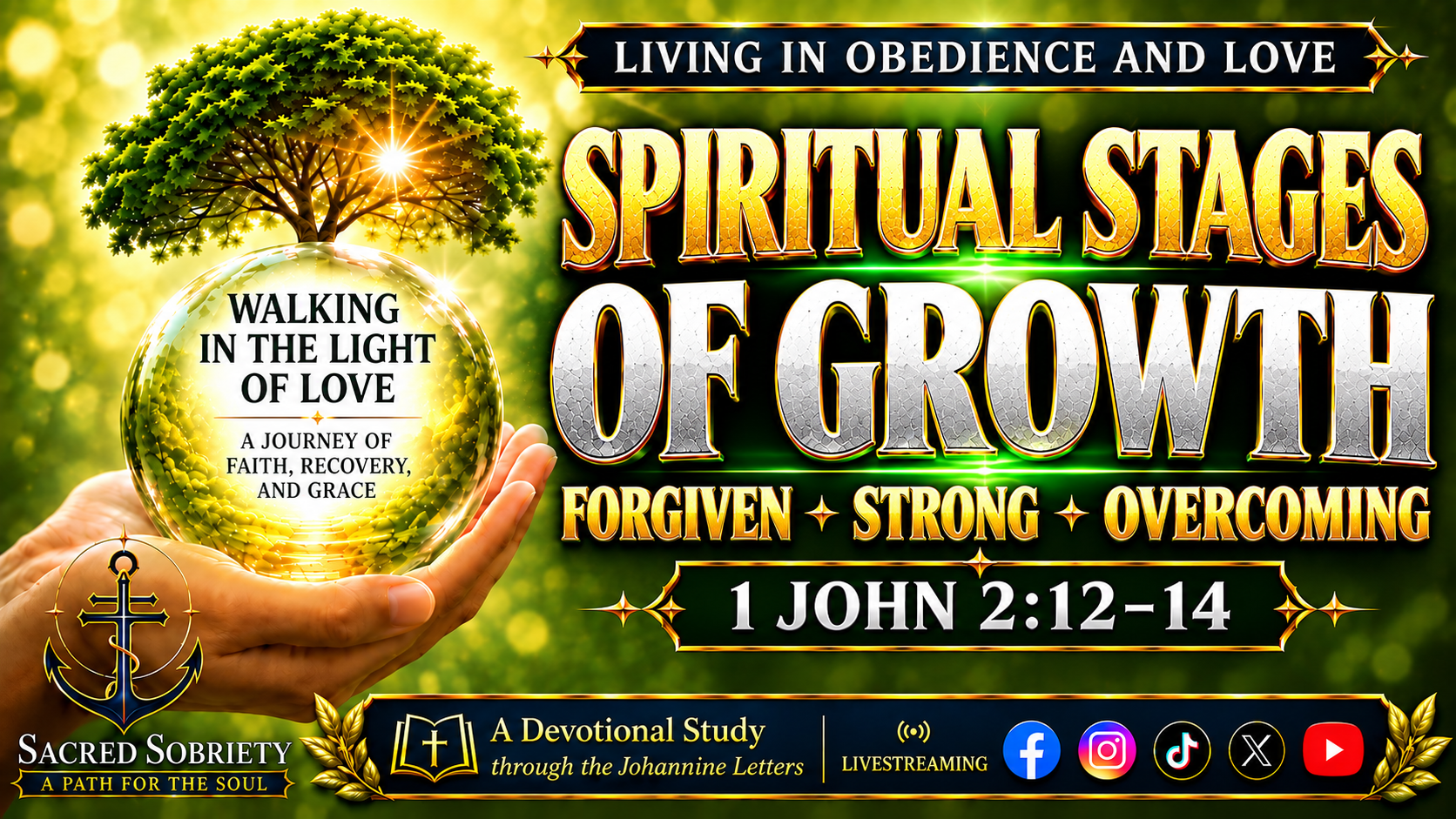
Spiritual Stages of Growth: 1 John 2:12-14 Devotional

Living in Obedience and Love —
A Devotional Study Through the Johannine Letters
Sacred Sobriety: A Path for the Soul | Anchored in Christ | Thriving in Sobriety
What if spiritual maturity is not measured by how little you struggle, but by what now abides within you when the struggle comes? John writes to little children, fathers, and young men, reminding them that they are forgiven, that they know the Father, that the Word of God abides in them, and that they have overcome the wicked one. This is not simply a description of where believers are. It is a picture of what grace is progressively forming us to become.
For those of us walking the path of recovery and sobriety, this matters deeply. We are not merely trying to survive another day without returning to old patterns. We are learning how to become men and women whose lives increasingly reflect the character, faithfulness, strength, and love of the God who redeemed us.
Forgiven, Growing, and Overcoming
“I write unto you, little children, because your sins are forgiven you for his name’s sake. I write unto you, fathers, because ye have known him that is from the beginning. I write unto you, young men, because ye have overcome the wicked one.” — 1 John 2:12–13, KJV
There are moments in our journey when we wonder whether we have actually grown. We remember where we have been, what we have done, relationships that remain fractured, opportunities we lost, people we disappointed, and consequences that cannot simply be erased. Recovery may have given us distance from the destructive behaviors of our past, yet certain wounds still follow us into the present. Shame has a way of pointing backward and saying, “Look at all the evidence that you failed.”
John points us somewhere else. He begins with forgiveness: “Your sins are forgiven you for his name’s sake.” Before John talks about strength, overcoming, maturity, spiritual warfare, or knowing God deeply, he begins with grace. Our spiritual development does not begin with proving ourselves worthy of God. It begins with recognizing what God has already accomplished through Jesus Christ.
The phrase “for his name’s sake” carries extraordinary weight. In Scripture, a name represents more than a label. It speaks of character, authority, reputation, purpose, and covenant faithfulness. When John says our sins are forgiven for His name’s sake, he directs our attention away from our ability to compensate for our failures and toward the character and redemptive work of Christ.
The Psalmist uses similar covenantal language when he declares, “He restoreth my soul: he leadeth me in the paths of righteousness for his name’s sake” (Psalm 23:3). God restores because restoration reveals who He is. His mercy does not diminish His holiness, and His justice does not extinguish His compassion. Redemption demonstrates the glory of a God who remains faithful to His promises even when fallen humanity desperately needs rescuing.
This is where recovery becomes more than behavior modification. Through Christ we are invited into genuine fellowship with our Heavenly Father, and through that fellowship we begin learning how to live differently with one another. John has been developing this theme from the beginning of his letter: fellowship with the Father, fellowship with the Son, walking in the light, confessing our sins, receiving cleansing, and learning obedience through love. Spiritual growth develops within that covenantal relationship.
John therefore speaks to his readers with familial language: children, fathers, and young men. We should be cautious about turning these expressions into a rigid spiritual ranking system. “Little children” is one of John’s affectionate ways of addressing believers generally, while fathers and young men may also represent differing degrees of spiritual experience and strength. Yet the progression offers us a powerful devotional picture: we receive forgiveness, come to know our Father, become strengthened by the Word, learn to overcome what once mastered us, and eventually become capable of strengthening others.
That progression speaks directly to recovery. We do not remain forever at the place where our testimony is simply, “I stopped doing what was destroying me.” Grace calls us farther. We learn to say, “I know my Father. His Word abides in me. What once controlled me no longer possesses the authority it once had. I am becoming strong enough to walk beside another traveler.” That is the movement from merely surviving sobriety toward actually thriving in spiritual life.